
ISO 23875: the operator cabin air quality standard for mining and heavy equipment
A performance standard for the air an operator breathes inside the cab. This guide covers what ISO 23875 requires, what each number means, how systems are tested, and where cabin air quality fits into protecting operators.
Scope: Air quality control systems for operator enclosures, respirable particulate and CO₂ inside the cab.
Overview
What is ISO 23875?
ISO 23875 specifies the performance and design requirements for air quality control systems in operator enclosures, along with the methods to test them. Rather than a spec sheet, it defines measured outcomes for the air an operator actually breathes, and how to prove a cabin delivers them. It targets the two things an operator is exposed to inside the cab: respirable particulate and carbon dioxide (CO₂). Meeting it reduces particulate exposure and controls CO₂ inside the cab; it does not by itself make a site compliant with workplace exposure law, or address gases and vapours outside the enclosure.
Type
Performance standard
Covers
Pressure + Particulate + CO₂
Published
ISO 23875:2021 (Amd 2022)
Status
Adopted AS/NZS 2023
ISO 23875 is a performance standard, not a product rating. It defines the results a cabin's air quality control system must achieve and how to measure them, rather than prescribing one design. A system meets it when it is designed, built, and tested to the requirements below.
How the standard is structured
ISO 23875 Defined a Lifecycle, Not a One-Off Check
ISO 23875 treats cabin air quality as something maintained across the life of the machine. Performance is designed in, verified by testing, then held through operation and maintenance, with routine re-testing closing the loop.
Design
The enclosure is sealed and the air quality control system specified so it can hold pressure and filter effectively between maintenance intervals.
Performance Testing
Pressure, external air leakage, decay time, and CO₂ are measured against the requirements to confirm the system performs as designed.
Operation
Continuous monitoring of pressure and CO₂ validates performance in service. Doors and windows stay closed while the system runs.
Maintenance & Auditing
Filters and seals are serviced on schedule, with interim inspections, periodic re-testing, and records kept to show the cab still performs.
Why ongoing auditing matters
A cabin that passed its test on day one won't stay that way on its own. Filters load, seals wear, and pressure drifts. The standard reflects this: it points to a program of inspection, re-testing, and record-keeping so performance can be shown over time, not just at handover.
- Annual performance audit. The standard recommends auditing operator enclosure performance each year.
- Interim inspections. Maintenance checks through the planned maintenance cycle, with a template provided in the standard.
- Records and reporting. Performance test results and maintenance instructions are documented, alongside the supplier's declaration of conformity.
This is where a one-off install and a maintained system part ways. Demonstrating that a cab keeps meeting the requirements depends on continuous monitoring and a record you can point to, which is exactly what data logging and audit tracking are built to provide.
The annual audit and interim inspections are recommendations (Annex B, informative). The maintenance instructions, performance test report, and declaration of conformity are requirements (Clauses 5 and 6, normative).
The detail
What ISO 23875 Requires at Each Stage
ISO 23875 treats cabin air quality as a lifecycle. A cabin doesn't meet the standard by passing one test — it has to be designed to perform, tested to prove it, operated so performance is visible, and maintained so it stays that way. Each stage carries its own requirements, set out below with the clause each comes from.
Reference: ISO 23875:2021/Amd 1:2022 — Clauses 4, 5 and 6.
1Designed to Perform
Clause 4.2 — Engineering design
Before a cabin can hold pressure or filter effectively, it has to be built for it. The design stage is where sealing, airflow and filtration are engineered — get this wrong and no amount of fan speed will pass the performance tests later.
Cabin Sealing
The enclosure must be sealed at every ingress point — seals, welds, penetrations, windows — so it can hold positive pressure under vibration. Sealing is what makes pressurisation possible. §4.2.1
External Air Intake Placement
Fresh-air intake is ducted into the HVAC mixing plenum and positioned away from engine exhaust and other machines' emissions, to minimise what the filter has to remove. §4.2.2
Pre-cleaning and Prefilters
A precleaner or correctly sized prefilter removes coarse dust before the primary filter, extending filter life so the cabin holds performance between planned maintenance intervals. §4.2.2.1
Dual Filtration and Airflow Path
Both an external-air filter and a recirculation filter, with airflow directed over the operator's breathing zone then down to a low return — using gravity to draw particles away from the operator. §4.2.2.2
Filter Housings
Housings that seal against the filter, prevent incorrect or reversed fitment, and protect fragile media from damage during handling and installation. §4.2.3
2Tested to Prove It
Clause 5 — Performance testing
A design on paper isn't conformance. The cabin is put through four defined tests on the machine, each with a measurable pass criterion, and the results are recorded in a test report. This is the evidence layer that turns "should work" into "measured and passed."
| Test | What it checks | Pass criterion | Clause |
|---|---|---|---|
| Pressure | Cabin holds positive pressure across the fan-speed range with doors and windows shut | ≥ 20 Pa, ≤ 200 Pa | §5.1.3.1 |
| External leakage | Dust fired at the intake filter does not bypass the seal and enter the cab directly | < 100 µg/m³ | §5.1.3.2 |
| Decay time | After a dust spike inside the cab, the recirculation system clears the air back to clean | ≤ 25 µg/m³ in ≤ 120 s | §5.1.3.3 |
| CO₂ | With the cab occupied and sealed, CO₂ stays diluted by the fresh-air supply over 15 minutes | ≤ ambient + 400 ppm | §5.1.3.4 |
3Monitored in Service
Clause 4.3 — Monitoring devices
Once the machine is working, performance has to be visible to the operator in real time. The standard requires continuous monitoring of the two things that can drift during a shift, cabin pressure and CO₂, with monitor alarms that signals the operator.
Continuous Pressure Monitoring
Cabin pressure is monitored continuously and kept within the 20 to 200 Pa range. Staying above 20 Pa is what keeps the cabin holding enough positive pressure to prevent dust ingress. §4.1
Continuous CO₂ Monitoring
CO₂ inside the cab is monitored continuously and kept within ambient + 400 ppm. Operators generate CO₂ by breathing, and elevated levels dull alertness and decision-making. §4.1, Annex A
Two-stage CO₂ Alarm
A first alarm at 1,000 ppm and a second at 2,500 ppm, so a rising-CO₂ event (doors left open, extra occupants) warns the operator before it affects alertness. §4.3.2
Clear Visual Status
A green / amber / red display the operator can read from the seat: green in spec, amber approaching the limit, red when the audible alarm sounds. §4.3.2
4Maintained and Documented
Clause 6 & Annex B — Operation, maintenance, records
A cabin that passed on day one won't stay that way on its own, the condition changes when filters load, seals wear, pressure drifts. The final stage is the paperwork and the schedule that let you show a cab still performs: the records, the instructions, and the declaration that ties it all back to the standard.
Maintenance Schedule & Filter Records
A servicing schedule with filter change records and interim inspections through the planned maintenance cycle, kept so cabin performance can be shown over time. §6.2, Annex B
Operation & Maintenance Instructions
Operator and maintenance information — filter classifications, maximum occupancy, servicing guidance — provided per ISO 6750-1. §6.1
Declaration of Conformity
A supplier's declaration of conformity from the manufacturer or installer, per ISO/IEC 17050-1, stating the cabin and filtration conform to the standard. §6.3
Periodic Performance Audit
Re-testing of cabin performance, recommended annually, to confirm the system still meets the Clause 4.1 targets as it ages. Annex B
Scope
Who Do ISO 23875 Apply To?
ISO 23875 was developed for mining, but the standard states its design requirements are universal. They apply to any enclosed operator cab, fixed or mobile. Wherever people work shifts inside machine cabins in dusty or diesel heavy conditions, exposed to respirable dust, crystalline silica or diesel particulate, the same engineering keeps their air clean.
So if your operators spend shifts in cabins near drilling, loading, hauling, crushing or fixed plant, ISO 23875 gives you a proven benchmark for cabin air quality, whatever industry you're in.
Industries this may include:
How we help
Supporting Your Cabin to Exceed ISO 23875
Pressurisation is one of the most effective engineering controls for reducing the contaminants that reach an operator inside the cabin. But ISO 23875 doesn't just ask for a good system, it asks you to prove the system performs. BreatheSafe supports both through four pillars that work together: the cabin system itself, and the testing, monitoring and records that prove it meets the standard.
Four pillars of BreatheSafe air pressurisation system

Positive Pressure
Sustained pressure above the ≥20 Pa floor keeps contaminated air out of a sealed cab.
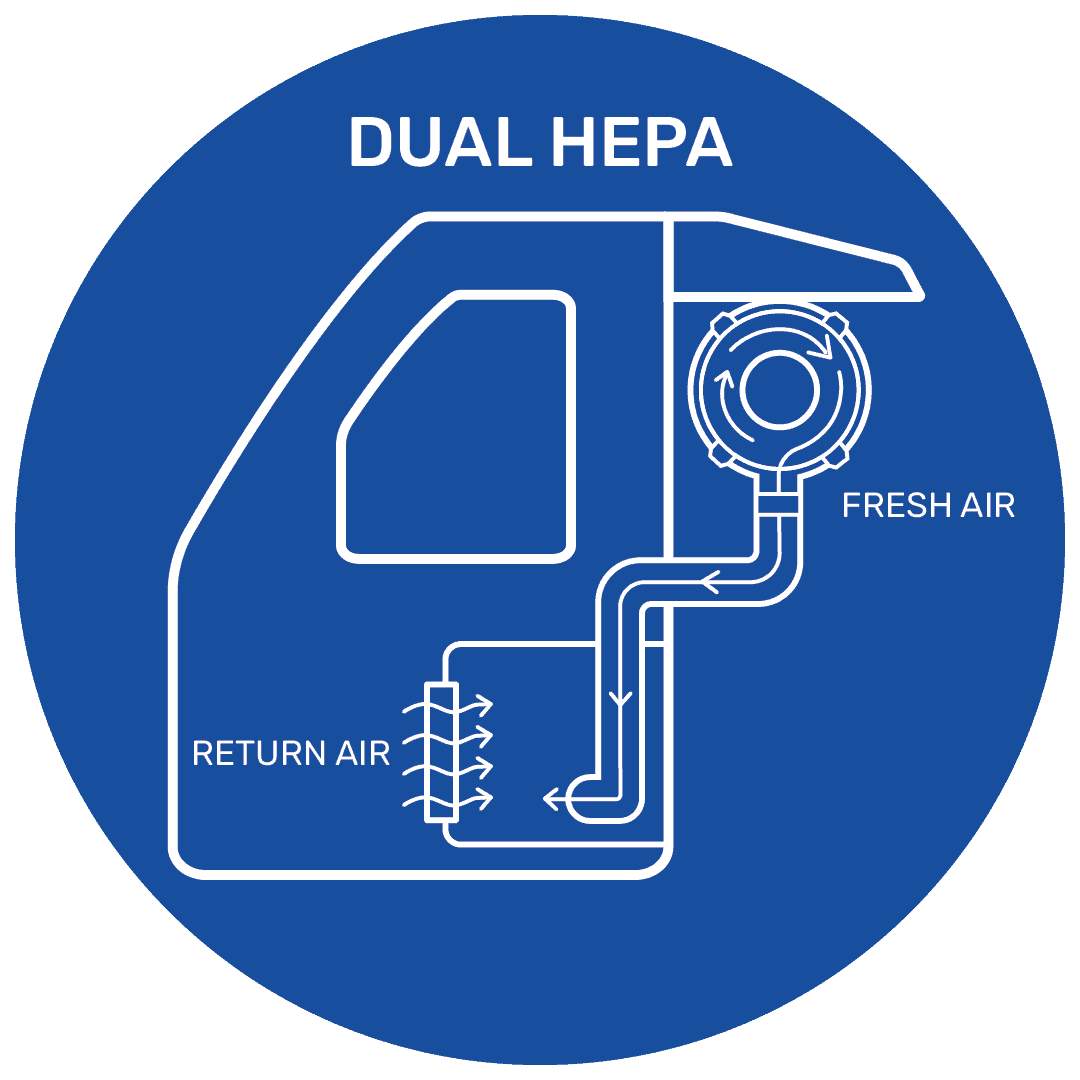
Dual HEPA Filtration
External and recirculation HEPA filtration, ensure a closed circuit filtration system.
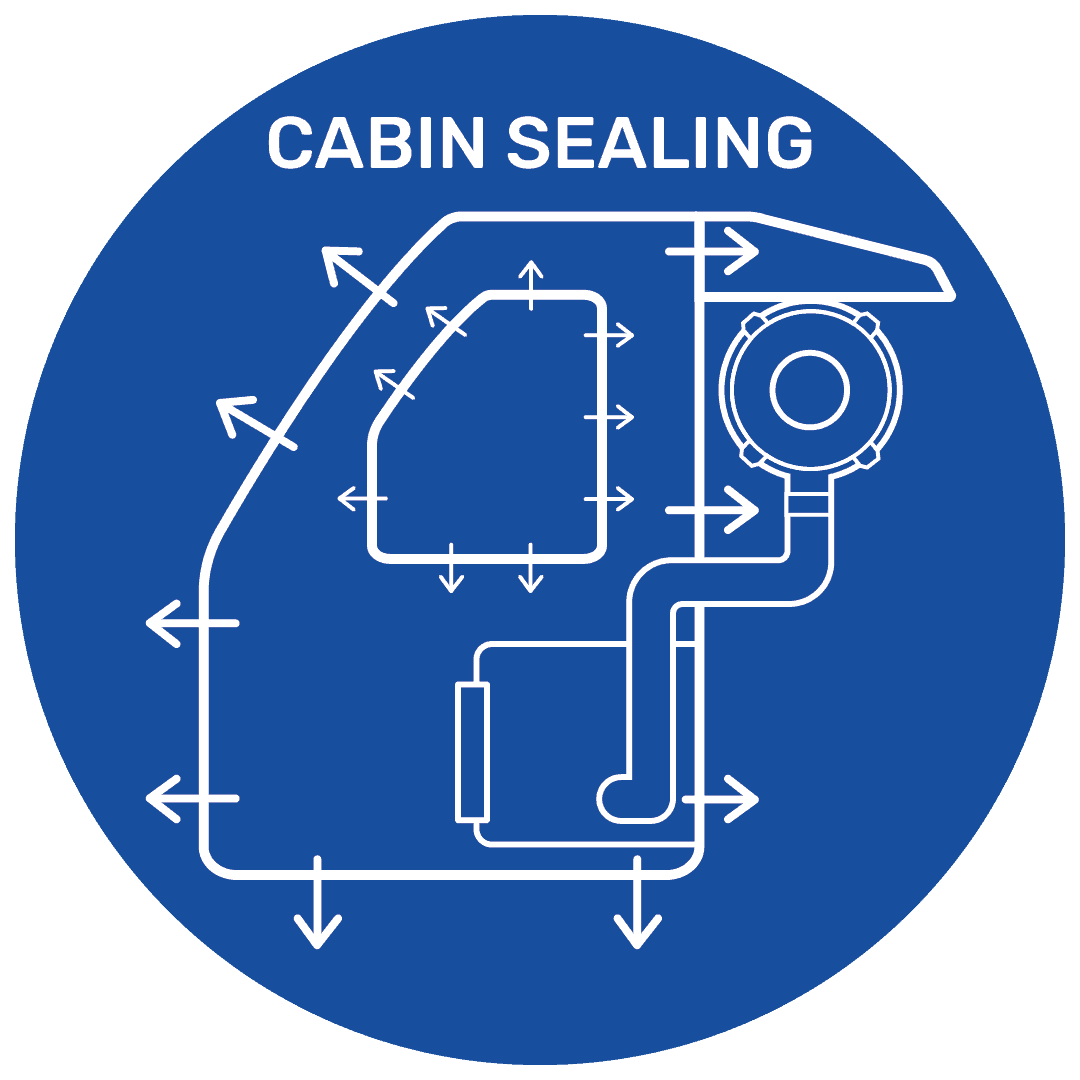
Cabin Sealing
Effective sealing lets the operator cabin hold positive pressure to prevent dust ingress.

Air Quality Monitoring
Continuous pressure & CO₂ logging, so conformance to the standard is recorded through the shift.
Take it with you
Mobile Equipment Cabin Review Checklist
Stand at the cab with the machine running and the doors and windows shut, then tick what you can confirm. Anything you can't tick shows where a repair, a test, or a record is still needed.
Frequently Asked Questions: ISO 23875
Is ISO 23875 mandatory?
What does ISO 23875 actually measure?
Four things, each with a defined test: respirable particulate inside the cab (≤25 µg/m³), how fast the cabin clears dust (decay time ≤120 s), sustained cabin pressure (≥20 Pa), and CO₂ (≤ ambient + 400 ppm). A cabin only conforms when it passes all four, which is why proving it takes proper testing, not just the right parts.
How do I know if my cabins meet ISO 23875?
What does it take to bring a cabin up to ISO 23875 standard?
It depends what the testing finds, but it usually comes down to sealing, the right dual filtration, reliable pressurisation, and continuous monitoring. BreatheSafe's systems are engineered to meet each of the standard's performance targets, and we support the retrofit, testing and records that prove it.
How is conformance proven and documented?
Can existing machines be retrofitted to meet ISO 23875?
How does ISO 23875 relate to the WEL or MSHA silica rule?
CAbin performance Review
Find out how your cabins measure up to ISO 23875
Send us your machine details and site conditions. We'll test cabin pressure, filtration, monitoring and records against the standard, and provide you with a documented result tested per standard.
— On the machine testing to the standard's methods
— A recorded result and declaration of conformity
— Retrofit and monitoring options for any fleet