
MSHA Silica Rule: MSHA lowered the silica limit for every US mine.
The rule sets one exposure limit for the air miners breathe, and puts engineering controls first. Its compliance dates are stayed in the courts right now, but the operators who fit and prove their cabin controls during the pause are the ones who will not be scrambling when it lands.
Scope: respirable crystalline silica under 30 CFR Part 60, and where a pressurised operator cab fits as an engineering control.
Overview
What is the MSHA Silica Final Rule?
MSHA's 2024 final rule replaces a patchwork of older silica limits with a single standard for every mine in the country. It lowers the permissible exposure limit for respirable crystalline silica to 50 micrograms per cubic metre over a full shift, sets an action level at half that to trigger monitoring early, and puts engineering controls ahead of respirators.
Rule
Respirable Crystalline Silica
Citation
30 CFR Part 60
Effective
17 June 2024
Status
Mandatory · dates stayed
A pressurised, filtered operator cab is one engineering control at the top of MSHA's hierarchy. It reduces the operator's exposure inside the cab for the hours they spend there. It does not by itself make a site compliant, and it does not replace sampling, source controls, respiratory protection, medical surveillance or records. Whether exposure sits within the limit is settled by the site's own sampling results.
Where it stands
The deadline is postponed, not cancelled
The rule text is on the books and took effect on 17 June 2024, but the compliance deadlines that would make it enforceable have been paused. Industry groups challenged the rule in the US Court of Appeals for the Eighth Circuit, and on 11 April 2025 the court stayed the rule's compliance deadlines while it reviews the case. MSHA has continued to enforce the older silica standards in the meantime.
The original compliance dates — 14 April 2025 for coal mines and 8 April 2026 for metal and nonmetal mines — are not currently being enforced. On 6 April 2026, MSHA published a Federal Register notice (91 FR 17143) delaying the metal and nonmetal conforming amendments indefinitely, pending judicial review, and confirmed it will continue enforcing the existing standards in 30 CFR parts 56 and 57 until the stay is lifted. MSHA has said it will publish a further notice announcing next steps once the court's stay is terminated.
None of that changes the underlying exposure. The particles, the diseases and the physics of keeping dust out of a cab are exactly the same whether the deadline is this year or two years out. Operators who treat the pause as time to build rather than time to wait are the ones who will absorb the final rule without disruption.
Status current as of July 2026. Confirm the latest position on MSHA's silica rule resources before making compliance decisions.
Sources: Federal Register, 91 FR 17143 · MSHA PIB P26-01
What's enforced today, and what's coming
For metal and nonmetal mines, the practical question is what limit applies right now. The answer: the older standards, until the stay lifts. Here's the gap the new rule closes.
Enforced today - metal & nonmetal mines
100 µg/m³
Silica PEL, 8-hour TWA · 30 CFR 56.5001 / 57.5001
No action level — nothing triggers early monitoring below the limit
No required medical surveillance for metal and nonmetal miners
Standards based on an exposure value set in the late 1960s
When enforcement resumes - all mines
50 µg/m³
Silica PEL, 8-hour TWA · 30 CFR 56.5001 / 57.5001
25 µg/m³ action level triggers monitoring and control review early
Medical surveillance extended to metal and nonmetal mines · §60.15
Feasible engineering controls required first, ahead of respirators · §60.11
The permissible limit halves when the stay lifts. That gap is the work the pause gives you time to do.
The detail
What the Rule Sets
The rule is anchored by a small set of numbers that apply uniformly to coal and metal and nonmetal mines. The action level is deliberately set at half the limit, so monitoring and control review are triggered before a miner ever reaches the permissible exposure limit.
Permissible Limit
full shift, 8-hour TWA, all mines
The ceiling · §60.10
Action Level
triggers additional monitoring
Periodic Evaluation
or sooner on any change
Ongoing review · §60.12
Forms Covered
quartz, cristobalite, tridymite
Alone or in any combination
The single limit applies to all three forms of respirable crystalline silica, whether alone or mixed, so a combination of forms cannot slip through by being counted separately. Sampling uses particle-size-selective devices that conform to the ISO 7708 convention, analysed by a laboratory using approved methods.
Want the rule's numbers and duties laid out on a checklist for an internal brief?
The obligations
What the Rule Requires
The rule builds a full loop around exposure: measure it, control it at the source, protect miners while controls are brought up to standard, watch their health over time, and keep the records that prove it. The engineering control obligation is the one that shapes an equipment decision.
01
Monitor Exposure
Sample each miner who may be exposed, to the full shift 8-hour average, using ISO 7708 particle-size-selective devices and approved laboratory analysis. Results are recorded and posted for the workforce.
§60.12 · Sampling
02
Engineering Controls First
Install, use and maintain feasible engineering controls, supplemented by administrative controls only where needed. Rotating miners through a dusty task to spread the dose is specifically not accepted as a control.
§60.11 · Hierarchy
03
Protect, Watch, Record
Respirators to the ASTM F3387-19 standard supplement controls when exposures are exceeded. Medical surveillance comes to metal and nonmetal mines, and sampling records are kept and reported.
§60.14 · ASTM F3387-19
Why the hierarchy matters for equipment: engineering controls sit at the top because they reduce exposure at the source and do not depend on a person remembering to act. A sealed, pressurised, filtered cab is exactly that kind of control for the operator's own breathing zone.
Scope
Who Do MSHA Silica Rule Apply To?
The MSHA silica rule reaches across the whole industry rather than a single commodity. Coal and metal and nonmetal operations share the same limit, the same action level and the same monitoring logic. If miners at your site work around drilling, cutting, crushing, screening or hauling material that contains crystalline silica, this silica rule applies.
Industries this may include:
How we help
Supporting Your Cabin to Exceed MSHA Silica Rule
Pressurisation is one of the most effective engineering controls for reducing the contaminants that reach an operator inside the cabin. BreatheSafe supports both through four pillars that work together: the cabin system itself, and the testing, monitoring and records that prove it meets the standard.
Four pillars of BreatheSafe air pressurisation system
Positive Pressure
Sustained pressure keeps dust-laden air out of a sealed cab for the operator's full shift.
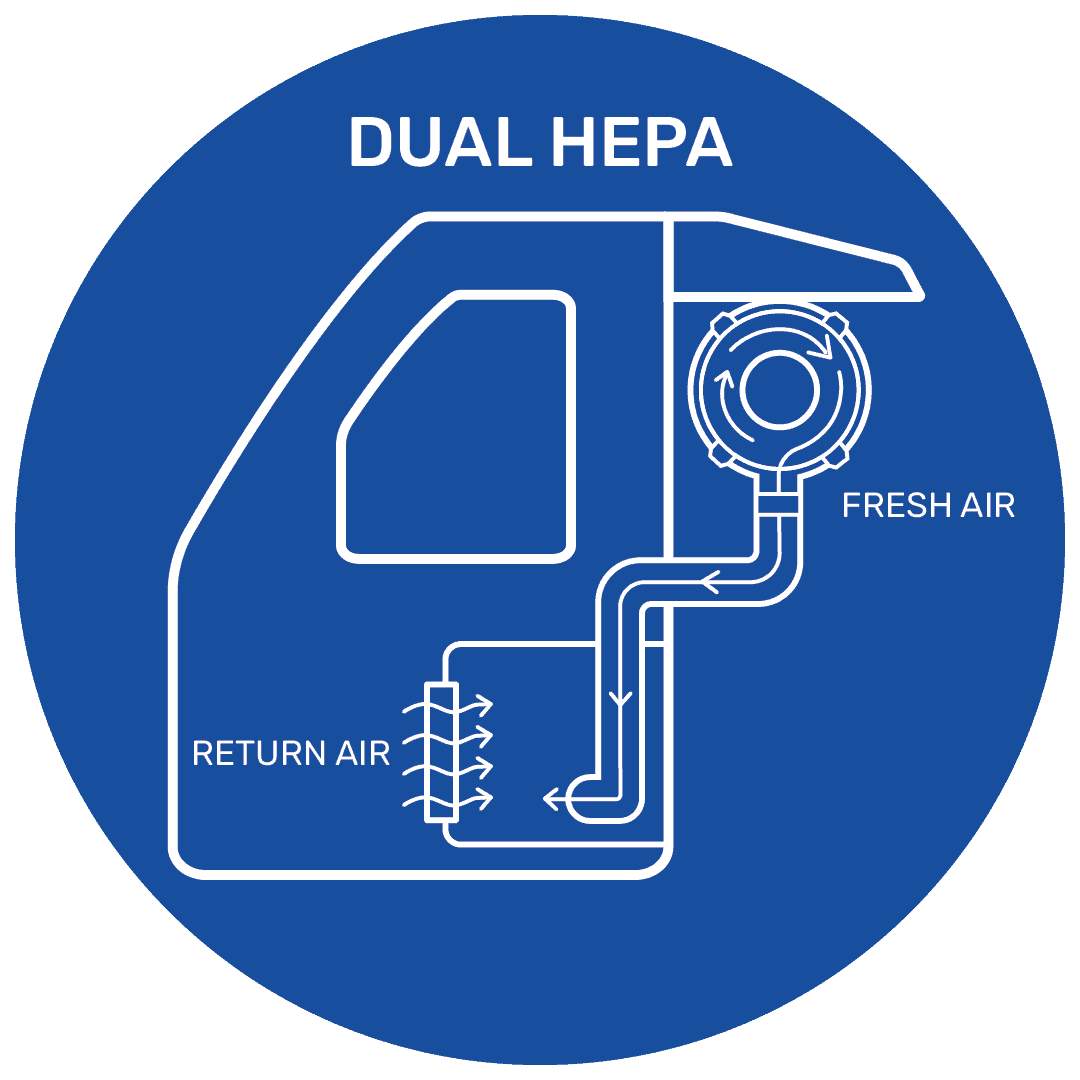
Dual HEPA Filtration
External and recirculation HEPA filtration, ensure a closed circuit filtration system.
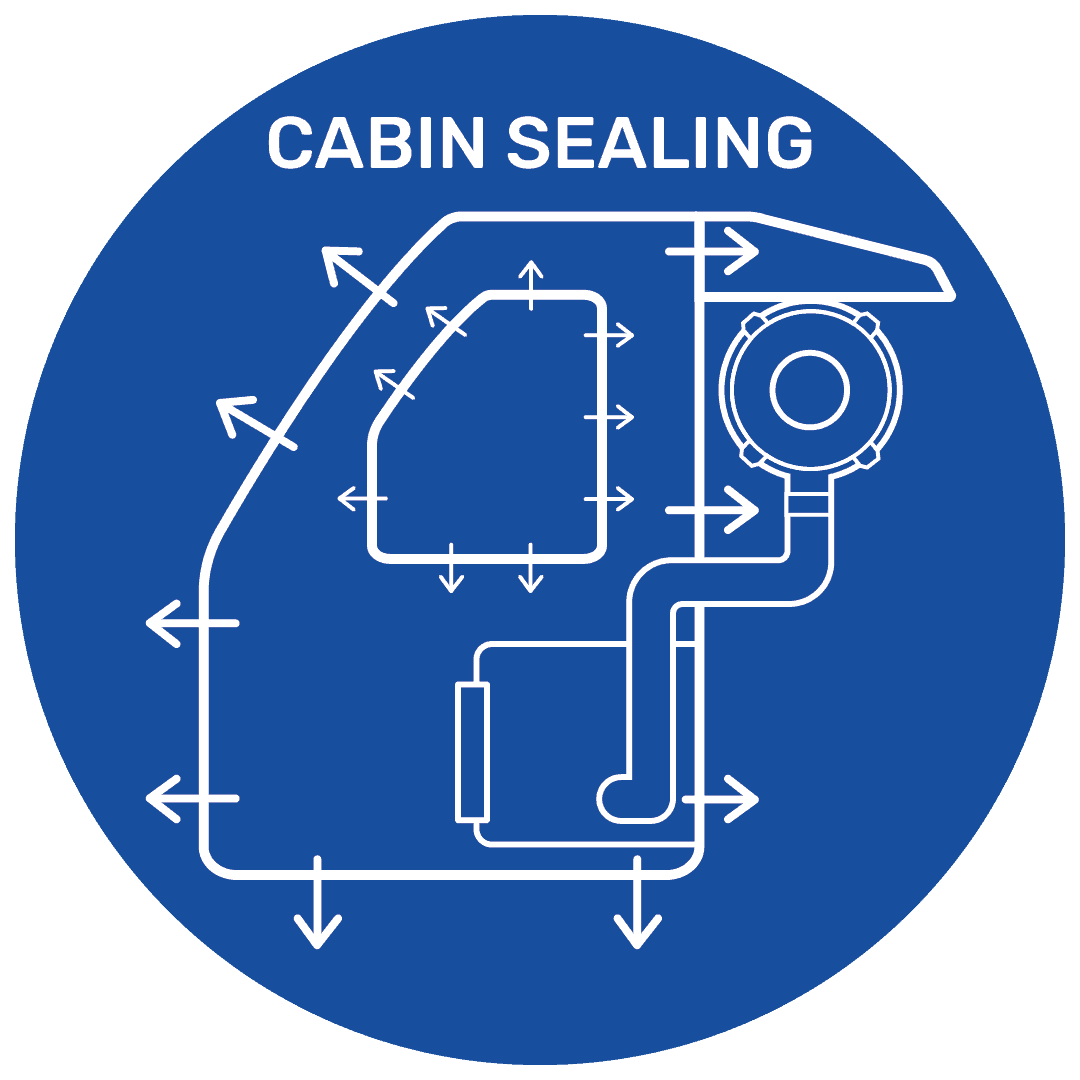
Cabin Sealing
Effective sealing lets the operator cabin hold positive pressure to prevent dust ingress.

Air Quality Monitoring
Continuous pressure & CO₂ logging, so conformance to the standard is recorded through the shift.
Take it with you
Mobile Equipment Cabin Review Checklist
Stand at the cab with the machine running and the doors and windows shut, then tick what you can confirm. Anything you can't tick shows where a repair, a test, or a record is still needed.
Frequently Asked Questions: MSHA Silica Rule
If the compliance deadline is stayed, why act now?
How does a pressurised cab help us meet the silica rule?
It cuts the dust reaching the operator during the hours they spend in the seat, which is where a large part of their full-shift exposure is decided. It sits at the top of MSHA's hierarchy as an engineering control, ahead of respirators, and its logged performance gives you evidence to show an inspector. Site-wide compliance still rests on your own sampling and the wider programme, and a well-performing cab is one of the strongest contributions you can make to it.
What is the difference between the action level and the permissible limit?
Why does the rule put engineering controls ahead of respirators?
Because a control that encloses the operator or works at the source does not depend on a person wearing it correctly for a full shift. The rule requires feasible engineering controls first, with respirators as a supplement rather than the plan, and rotating miners through a dusty task to share the dose is specifically not accepted. A sealed, pressurised cab is exactly the kind of control the rule wants you to reach for first.
Does the rule apply to coal and metal and nonmetal mines the same way?
Can our existing machines be retrofitted rather than replaced?
Get ahead while the clock is paused
Find out how your cabins Exceeds Msha Silica Rule
Send us your fleet details and site conditions. We'll help review and fit cabin pressurisation, HEPA filtration and monitoring, so your operator cabs are ready as a documented control before MSHA enforcement resumes.
— On the machine testing to the standard's methods
— A recorded result and declaration of conformity
— Retrofit and monitoring options for any fleet